
The Dispatch Console Buying Guide

Updated: Mar 6

Who Is This Dispatch Buying Guide For?
This guide is intended to help you familiarize yourself with the buying process of dispatch consoles for emergency communication centers and PSAPs. If this is your first time building or renovating a control room, these are the steps you will need to follow.
What is a Dispatch Console?
Dispatch consoles are the "desks" and workstations found in mission-critical work environments dedicated to public safety. These consoles are used inside emergency communication centers where telecommunicators perform their tasks of call-taking and dispatching.
Keep in mind that control consoles are also used in monitoring operational activities for a variety of industries outside 911 telecommunications, including security, process control, energy, utilities, transportation, and military applications.


Dispatch consoles also differ from standard office furniture due to their need to withstand 24/7 use and integrate customized IT equipment. They also differ in technology integrations such as electrically height-adjustable surfaces, cable management solutions, occupancy sensors, CPU enclosures, power and data outlets, ergonomic design, and 24/7 use certification (among other features).
These control consoles are designed to provide users with ergonomic comfort while reducing environmental distractions to allow operators to focus on the task at hand. Since dispatch consoles are specialized furniture, when buying new ones it is important to consider many factors that will impact the design choices and other decisions to be made down the line. Review the guide to an ergonomic setup in a dispatch center here.
The 911 Dispatch Console Buying Process
1) Needs Recognition
The acquisition of dispatch consoles involves multiple stakeholders coordinating the project. You would normally start after realizing the existing furniture does not meet the current nor future needs of your control center. Likewise, if you are planning a budget for your PSAP, this is where you would normally start.
Common reasons for upgrading or replacing dispatch consoles include:
Moving out to a new location.
Consoles are outdated in terms of ergonomics or functionality.
Consoles do not meet your new IT requirements Poor cable management.
Void or soon-to-be expired warranty on consoles Consolidation between different agencies.
Low retention rate for skilled staff.
2) Initial Contact
At this stage, you have identified the need for new dispatch consoles and have started researching potential console providers. Contacting console manufacturers is the first step to help you better assess the different options available in terms of product design, service, and pricing.
3) Needs Analysis
Some of the topics discussed with dispatch console manufacturers in this stage include the project scope, console features, and budget. Most manufacturers have a comprehensive list of questions to help them better understand the scope of the project.
Important questions might include the number of workstations required, room dimensions, and the number of monitors and users. At Sustema, we take the time to understand your needs so we can offer the best possible solution for your control center.
We can have virtual meetings with your team members and guide you through a virtual showroom to showcase the different console models and features.
4) Dispatch Console Design Process
Step 1: Floor Plan & Technical Features
After we get a clear understanding of your needs, your Sustema representative will prepare and send the design criteria to our design department. Our team of industrial designers will recreate your floor layout and renderings of the new consoles based on your requirements.
Once the preliminary designs are completed, you and your team can review the proposed layout and get back to us with any questions or drawing modification requests. Sustema is proud to be recognized for the degree of customization we offer our customers.
Step 2: Design & Color Choice
When the technical design stage is completed, Sustema offers a wide variety of colors and styles to choose from to match the interior design of your facility. Multiple options are available for the work surface finish, edge styles, CPU enclosures, accessory colors, and more.

5) Purchase Order (P.O.)
Once the final drawings are signed and approved, Sustema will start the manufacturing process. The time-frame of this stage often varies as different departments in your organization may be required to approve the purchase order (P.O.).
6) Manufacturing
Once the P.O. is received, it will take approximately 8-10 weeks to manufacture all items. Our dispatch consoles are then pre-assembled and tested at our facility for quality assurance. Throughout the process, the Sustema representative will stay in contact with your team to provide updates and answer any questions that you may have.
7) Installation
At this stage, Sustema’s representative and project coordinators will help you plan the installation at your facility. Sustema will take care of all the logistics with other contractors to ensure a smooth and easy installation. Our team of certified installers has security clearances to some of the most secure facilities and can also take additional site-specific training to meet your safety protocols.
8) Warranty
Sustema stays committed to providing the most advanced and ergonomic console solutions. With over 30 years of experience in the industry, we are now one of the leading dispatch console manufacturers in North America. Sustema offers a limited lifetime warranty on its control room and dispatch consoles.
How Long Does it Take to Receive the New Consoles?
While no two projects are the same and timelines may vary, having a specific date in mind to have the project completed can make it easier to "reverse engineer" the whole process and determine when consoles need to be ordered.
On average, it takes approximately 8-10 weeks to receive the consoles at your facility from the date that the designs and purchase order (P.O.) are approved.
Example: For example, if the center needs to be operational by January 1, 2027, the P.O. and final designs must be approved by the second week of October 2026 at the latest.
What are the different types of dispatch consoles available?


Types of Dispatch Consoles
When it comes to dispatch centers, no two facilities are the same. Room dimensions, IT/power requirements, the number of users, the number of LCD monitors, and even the type of application will almost always differ. These elements will all have an impact on the final design and features of the console.
For instance, one of the main differentiation factors when designing a dispatch console is the number of worksurfaces. Some consoles will have two surfaces to allow for a separate monitor and keyboard surface, whereas others will only have one where all the accessories and monitors will be mounted on. Next, we will go over the key differences between the two options of worksurfaces available on consoles.

Single Surface Dispatch Consoles

Single surface dispatch consoles are available in two formats: fixed work surface or height-adjustable work surface. The number of monitors, CPUs, and other IT equipment needed on the console will influence the type of surface that it will require. This is why it is important to understand how the console will be used by the operators. Other factors may include the amount of time spent by the operators at their workstations, the cable management system, and power requirements.
Requirements for a fixed height work surface control console
Consoles with a fixed worksurface require a sturdy leg system to support the IT equipment, CPU monitors, and work surface itself. Sustema uses a steel base structure for all of its consoles to ensure the stability of the workstation over time.
The leg system is mounted to the console’s back wall which also serves as a cable management system. Inside the wall, you will find separate cable raceways through which the power/data cables, power bars, and telephone/radio lines will run.

The CPU enclosures are attached directly to the lower base of the wall and are easily accessible underneath the console for troubleshooting.
The wall system not only serves as a support but can also be used to integrate power/data outlets. The wall system can also be used to mount accessories such as phones, laptops, and file holders, and monitor arms - creating a clutter free workspace.
Dual Surface 911 Dispatch Consoles
Dual surface dispatch consoles offer the greatest flexibility in terms of ergonomics, functionality, and technology. The electrically height-adjustable surfaces can be raised or lowered independently from each other, enabling users to set their preferred height for monitors and for their mouse and keyboard.
In other words, the primary surface serves as the workspace for users, and the secondary surface serves as a support for the monitors. Since users can set their preferred height on each surface, dual surface consoles offer a more comfortable work experience in both the sitting and standing position.
Dual surface consoles like the Transit C-300 series also integrate a cable management system inside the CPU enclosures and underneath the console surfaces. The CPU enclosures are secured, ventilated, and can host all the IT equipment required for 24/7 work environments (such as KVMs, 19" rackmounts, and multiple power bars).
Types of Floor Layouts
Dispatch Center Floor Layout & Configurations
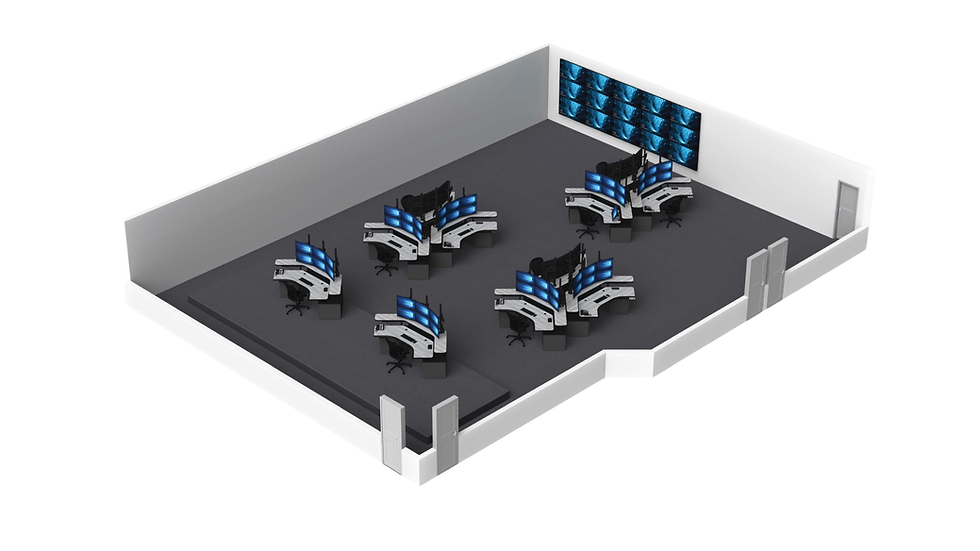
A key element to consider when designing furniture for dispatch centers is the way in which the layout can maximize the efficiency and workflow of operators. The console shape, design, and dimensions can all have an influence on the floor layout configuration. Other elements to consider include the number of users on each workstation, the foot traffic during work hours, the required power and data sources, and even the way in which people need to collaborate with each other in the workplace.


Custom Floor Layout Configurations
Tangible factors like electrical and ventilation have to be considered when planning your dispatch center layout. Equally important are intangible elements such as acoustics, lighting, interior design, and the overall atmosphere of the room. Learn more about setting up an ergonomic dispatch console here.
Always keep in mind the main purpose of the emergence dispatch center:
Is there anything working against team collaboration in the dispatch call center? For example, the position of the furniture and the design of the alleys.
Can a supervisor see all operators in the PSAP?
Can they walk to them in a realistic and direct path?

Ready to plan your next dispatch console upgrade?
First, let's find out which control console is best for you so you can start the process of designing your new dispatch center. Take our Console Survey to tell us about your current setup and what your needs and requirements look like.


Comments